



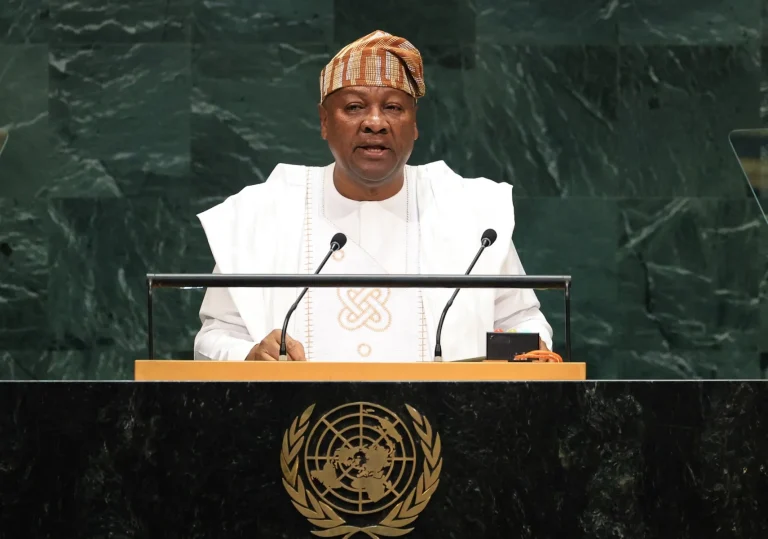
Ghana’s President, John Dramani Mahama, has opened up on why his administration declined a new health partnership proposed by the United States, saying the conditions attached were demeaning to the country’s sovereignty.
Speaking at the Council on Foreign Relations in New York on Friday, September 25, Mahama said the offer came after Washington overhauled its foreign assistance programme under President Donald Trump, leaving several countries, including Ghana, with reduced health funding.
He noted that the document was first examined by the Ministry of Health, which raised red flags before it was forwarded to Cabinet for final consideration.
One of the major sticking points, according to the President, was a demand for Ghana’s sensitive health information.
“The proposal stated that we must hand over our pathogen profile and our citizens’ medical records to the US. What country hands over its entire medical records to another country?” he queried.
Mahama further disclosed that the compact required Ghana to provide counterpart financing for health services.
He also faulted a provision that would have prevented Ghana’s Food and Drugs Authority from vetting drugs and medical commodities shipped into the country under the arrangement.
“It provided that any medicines brought in under the programme could not be inspected by our own FDA. That was completely humiliating,” he said.
The President revealed that Cabinet dismissed the proposal without delay and instructed the Health Minister to formally notify the American Ambassador of Ghana’s position.
The proposed agreement, valued at about $109 million over five years, was linked to the US America First Global Health Strategy. Its rejection in April created a $74 million deficit in Ghana’s health sector, impacting HIV screening, antiretroviral supply, laboratory operations and research.
Mahama said the setback has accelerated Ghana’s Accra Reset initiative, which seeks to cut reliance on external health aid and scale up domestic manufacturing of drugs and vaccines, while still working with the US and other development partners.




Leave a comment