





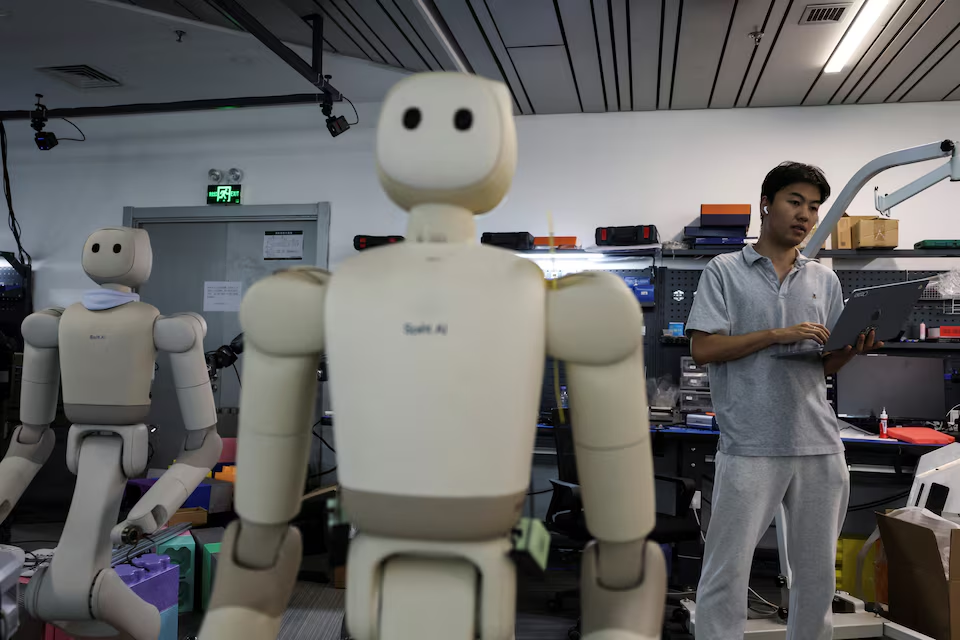
Humanoid robots will carry out most general tasks from voice instructions as early as next year, but becoming useful in homes will take much longer, Spirit AI co-founder Gao Yang told Reuters in Beijing on Thursday.
He said hardware has advanced enough for Chinese humanoids to sprint and do backflips, but focus has shifted to the software that drives intelligence for productive work, known as “embodied AI”. “The brain is indeed the weakest link in the complete robotics stack,” Gao said.
The industry is chasing its “ChatGPT moment”, the breakthrough that made generative AI mass market after OpenAI launched ChatGPT in 2022. “We anticipate reaching the GPT-3.0 milestone by mid 2027. You will be able to speak to a robot in natural language, and it will execute a series of reasonable physical actions to attempt the task,” Gao said.
Spirit AI employs about 1,000 contractors who wear sensors at home and in factories to capture human movement. At its Beijing training centre, dozens were seen repeating tasks like opening fridges and cutting vegetables. Its robots now have a 90% success rate for simple tasks in living rooms.
“The next one to two years mark the initial window for industrial applications. Two years from now, we’ll see robots deployed in commercial service settings doing simpler tasks. Entering homes is far harder than both,” Gao said.
The 300-person startup, valued at $2.9 billion after raising over $670 million since 2024, already has tens of its Moz1 wheeled robots deployed at CATL and http://JD.com.
“Progress is extremely fast. When Spirit AI was founded, a robot could perform only one isolated task well, like pouring water or folding a piece of clothing,” Gao said. “Today, robots operate across large spatial areas and execute continuous complex workflows.”
The firm uses real world “dirty data” rather than simulations, arguing some tasks can only be learned from physical interaction. “Simulators handle rigid bodies well, but flexible objects like deformable electric cables remain a problem,” he said.
On safety, Gao said, “Our robots feature whole-body force control. If the robot encounters excessive interaction force with the environment, emergency braking triggers automatically as a baseline safety policy.”








Leave a comment