





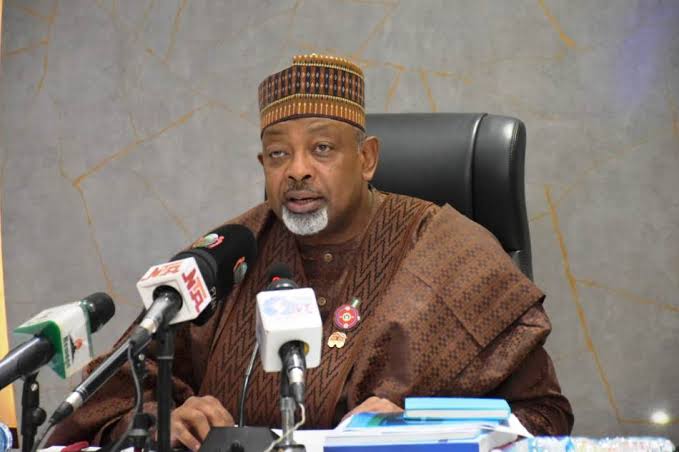
The Minister of Agriculture and Food Security, Abubakar Kyari, has said food production has improved under President Bola Tinubu, but prices remain high because of problems in processing and distribution.
Kyari said farm gate prices have dropped, yet consumers are not feeling the impact because of bottlenecks between farms and markets.
He spoke in an interview with ARISE NEWS on Friday when asked why government reforms in agriculture have not led to lower food prices for Nigerians.
He said when compared to 2023 and 2024 figures, the reforms of the current administration have put the country on the right track.
“Let’s go down memory lane and think about the figures in 2023 and 2024. When you look at those and compare them with what the reforms of President Bola Ahmed Tinubu’s administration have done, we are on the right track,” he said.
The minister explained that data from the National Bureau of Statistics shows production costs have fallen but agro processing costs have not.
He said this shows that while food is cheaper at the farm gate, other gaps in the value chain need to be fixed. Kyari listed population growth, low productivity, poor access to land and high input costs as reasons Nigeria still relies heavily on food imports.
He noted that Nigeria adds about 8 to 9 million people yearly, which makes it difficult for food supply to catch up with demand. He said improving seed quality and giving farmers subsidised inputs are key steps the government is taking.
According to him, the government is working to reduce dependence on processed food imports through mechanisation and local value addition.
He pointed to the ban on export of some raw commodities like shea nuts and the Special Agro-Processing Zones (SAPZ) as measures to boost local processing. He said eight SAPZs will come on stream before the end of next year, with a second phase covering about 10 states.
The zones, he said, will cover production, aggregation, storage, processing and marketing.
Kyari also said improved security has allowed farmers to return to farmlands that were previously inaccessible. He said this led to bumper harvests in 2024 and 2025, with 2026 expected to be better.
He added that agricultural production figures for 2026 will be released between October and November after the wet season harvest, while dry season figures will come in March and June.
The minister said tractor deployment under the mechanisation programme is ongoing, with each tractor expected to cover 500 to 600 hectares yearly. With 2,000 tractors, he said about one million hectares can be prepared annually.
He said interventions through the Bank of Agriculture and the National Agricultural Development Fund, including free and subsidised fertiliser, have helped stabilise input prices.










Leave a comment